

Speaking of Cranford
Elizabeth Gaskell's quaint fictional village pops up in unlikely places

There are a handful of literary references that I “collect,” out of a combination of fondness for the source material and the relative rarity of finding it mentioned in fiction nowadays. It evokes both a chuckle and the feeling of finding an old coin or recognizing a maker’s mark in an antique shop when I come across an author of vintage popular fiction lightly referencing a lesser-known classic in a way that clearly assumed their readers would know exactly what they were talking about.
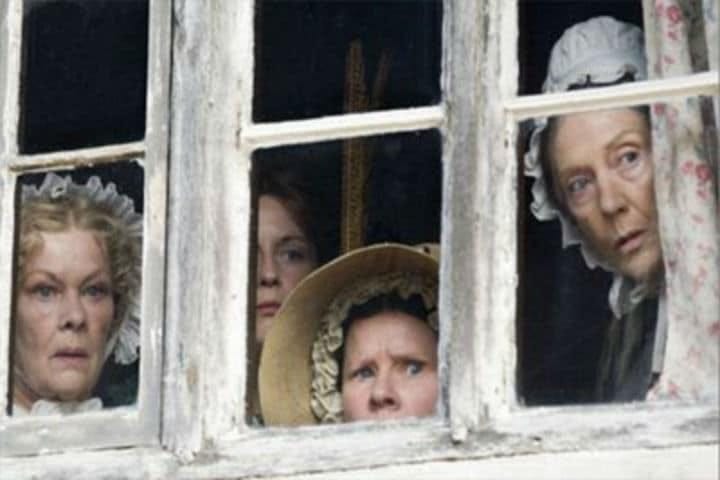
Charles Dickens’ Martin Chuzzlewit heads my random little list, as I’ve written about before. A mention of Anthony Trollope’s fictional county of Barsetshire or city of Barchester also delights me. Rather more difficult to explain is that I report to my brother whenever I come across a reference to George Borrow (it happens more often than you’d expect). And then there is Cranford, most quaint and quirky of fictional English villages. I had never heard of it before the delightfully funny—and endlessly quotable—2007 BBC miniseries (based, actually, on three separate novellas by Elizabeth Gaskell which are close enough kin to fit together perfectly), but it becomes quite clear when reading older books that the average late-19th and early-20th-century reader knew Cranford and was fond of it.
Consider this paragraph:
Our village, King’s Abbot, is, I imagine, very much like any other village. Our big town is Cranchester, nine miles away. We have a large railway station, a small post office, and two rival “General Stores.” Able-bodied men are apt to leave the place early in life, but we are rich in unmarried ladies and retired military officers. Our hobbies and recreations can be summed up in the one word, “gossip.”
~ The Murder of Roger Ackroyd by Agatha Christie
With that description, and the fact that Cranford’s nearest “big town” is supposed to be Manchester, twelve miles away, it’s hard to imagine that Christie (who also heads the leaderboard in my collection of Martin Chuzzlewit references) was not making an affectionate Cranford reference here.
Other references are more overt:
She adds that she has never had time to write a book herself, but has often thought that she would like to do so. Little things, she says—one here, another there—quaint sayings such as she hears every day of her life as she pops round the parish—Cranford, she adds in conclusion. I say Yes indeed, being unable to think of anything else, and we part.
~ The Provincial Lady Goes Further by E.M. Delafield
“How does the new book come on?” asked Polly, sucking her orange in public with a composure which would have scandalized the good ladies of “Cranford.”
~ An Old-Fashioned Girl by Louisa May Alcott (thank you Melody Schwarting!)
As for Miss Araminta—I wish I could write a book and put Miss Araminta Armstrong in it. If the lady who wrote Cranford had known her she would have put her in, and it is a loss to literature that no one can do again for little places and the Miss Aramintas of life what the Cranford writer did.
~ Kitty Canary by Kate Langley Bosher
Even now her own letters to Peter were no sprightly scrawl of passing events, but efforts whose seriousness suggested, at least in their carefully elaborated stages of structure, the letters of the ladies of Cranford.
~ Judith of the Plains by Marie Manning
“There’s Margy, sayin’ Cranford would be real excitin’ alongside this place. She got real put out t’day, because you boys went off first thing this forenoon, and then Butch Cassidy come over and spent most all the time foolin’ around with Skookum and didn’t talk to her much, and somethin’ or other went wrong in her story—she was tellin’ me all about it while we washed up the dishes…”
“Cranford! Ye gods!” Bud exploded, tardily, the full enormity of the comparison striking him in the middle of demolishing the plate of chicken.
~ Meadowlark Basin by B.M. Bower
I have no proof, but a strong suspicion, that this may be the only time that Cranford and Butch Cassidy were ever referenced in the same paragraph.
If you enjoy The Second Sentence and you’d like to show appreciation without committing to a paid subscription, you could buy me a coffee or buy a book.
The Many Adventures of Martin Chuzzlewit

Though Martin Chuzzlewit is one of my own personal favorites of Charles Dickens’ novels, it doesn’t seem to get nearly as much appreciation as books like David Copperfield, Great Expectations, or Oliver Twist. But if you judge by the amount of Chuzzlewit references and quotations scattered throughout other books in the late 19th and earlier 20th century…
My favorite Cranford reference is in An Old-Fashioned Girl by Louisa May Alcott: "'How does the new book come on?' asked Polly, sucking her orange in public with a composure which would have scandalized the good ladies of 'Cranford.'" (Chapter 13)